
OUP ANZ : a new website design
A teacher between lessons, searching for the right maths series and a sample to try in class, should be able to find it from a phone without hunting. For Oxford University Press ANZ (OUP ANZ), we designed the website that makes that possible.
The friction: a busy marketing team, a big catalogue and a platform move

OUP ANZ sells and supports learning resources across its divisions, from primary and secondary schools to higher education and English language teaching. Its marketing team lives by campaigns, and teachers decide quickly. Every landing page, book listing and sample request has to be easy to build and easy to use.
In 2025 the team was preparing to move oup.com.au onto Squiz DXP. That meant a new design, a new way of listing books, and analytics that had grown over many years. A small in-house team had to keep campaigns running while the platform changed underneath them.
OUP ANZ first brought us in to extend its in-house team. Then it asked us to design the new site. We treated it as one relationship: a six-person virtual team, led by a single digital producer who knew the business at every step.
"Having a single point of contact who understands our business needs and who can pull in the experience and skillsets as required depending on the task at hand worked well for our business. We always know that the right person will be put on the job."
Sarah Hossli, Head of Marketing, Oxford University Press ANZ
Our strategy: one point of contact, then a design OUP's team could build from
Support that worked like part of the team
From May to December 2025, a FrontStage Digital Producer worked with OUP's marketing and technology team, including one day a week in OUP's office, and pulled in our developers as each task needed. We worked in sprints and reviewed priorities regularly, and OUP could add resourcing when something urgent came up.
The work covered Squiz Matrix, Funnelback search and the SEO details that help teachers find the right title in search results. We set a default meta description, reduced duplicate page titles, updated image alt text and added canonical URLs to frontlist titles. We added Hotjar and the LinkedIn pixel for the marketing team, fixed and tuned Funnelback search, and wrote a content maintenance guide so OUP's team could keep working in Squiz without us.
Add a book by its ID, not by hand-coded HTML!
Here's the clever bit. Is a rush to meet deadlines and with no experience with Squiz DXP Marketers had been building book listings with hand-coded HTML!! We free up junior marketers to do more marketing and less page building. We specified and built a Book Listing component that ends that busy work. An editor picks a title by its asset ID, and the cover, title and details come from the book's own metadata.
OUP's marketing team used it to build new children's books and English language teaching landing pages in minutes. When we handed the new design over, Squiz was asked to review the component for reuse in the new build.
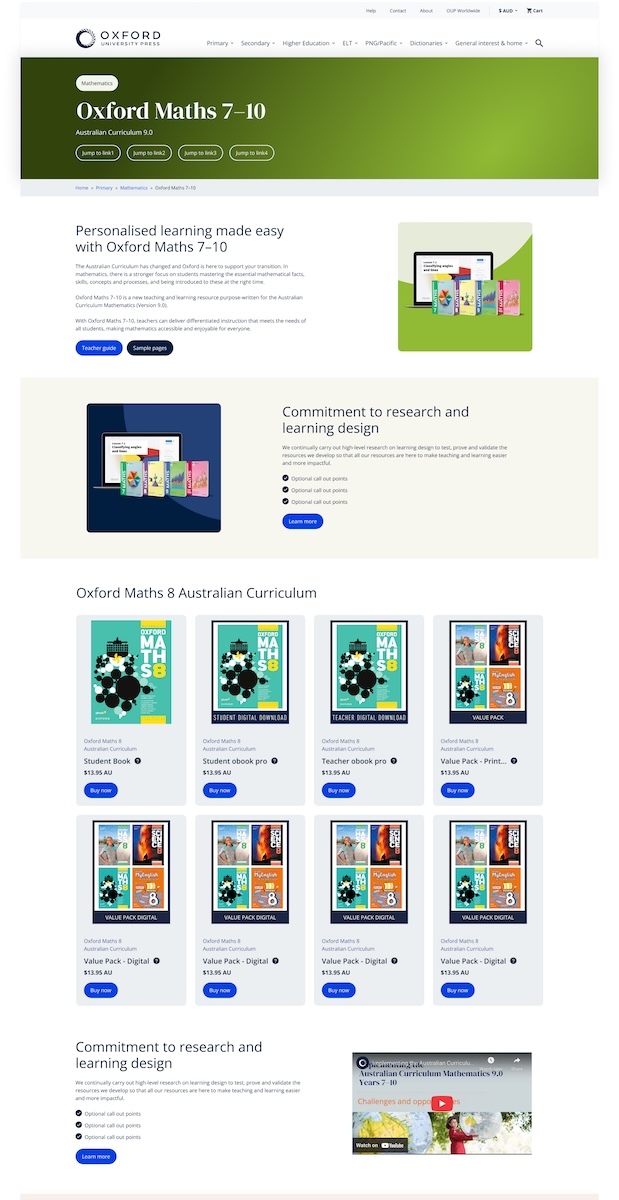
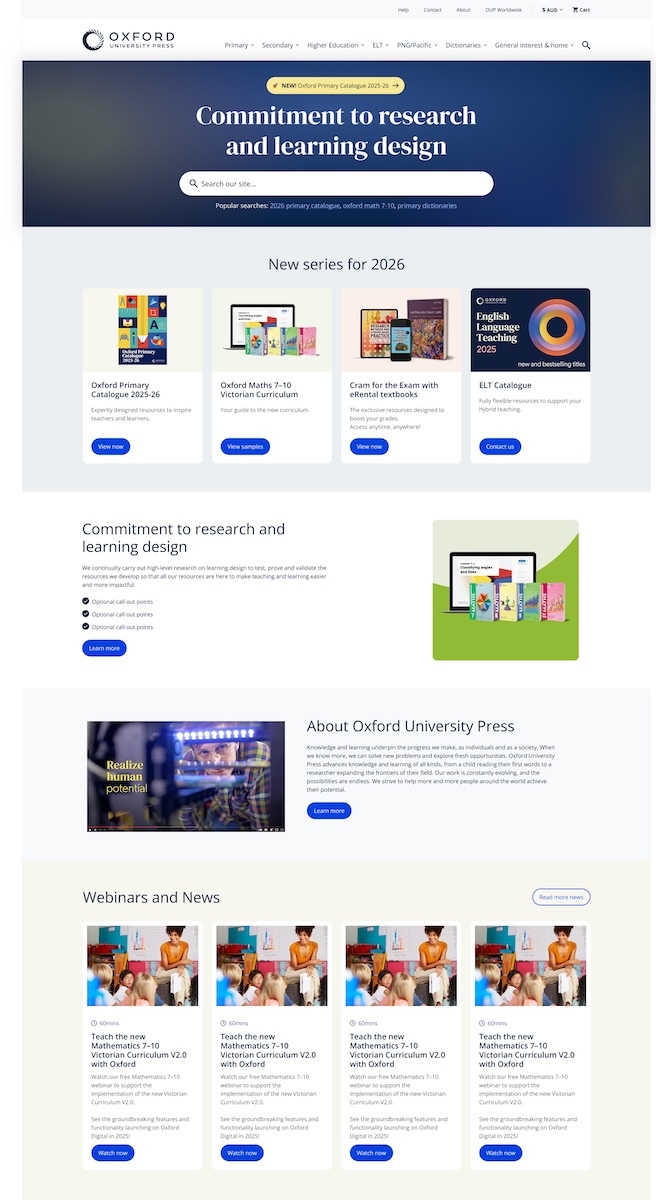
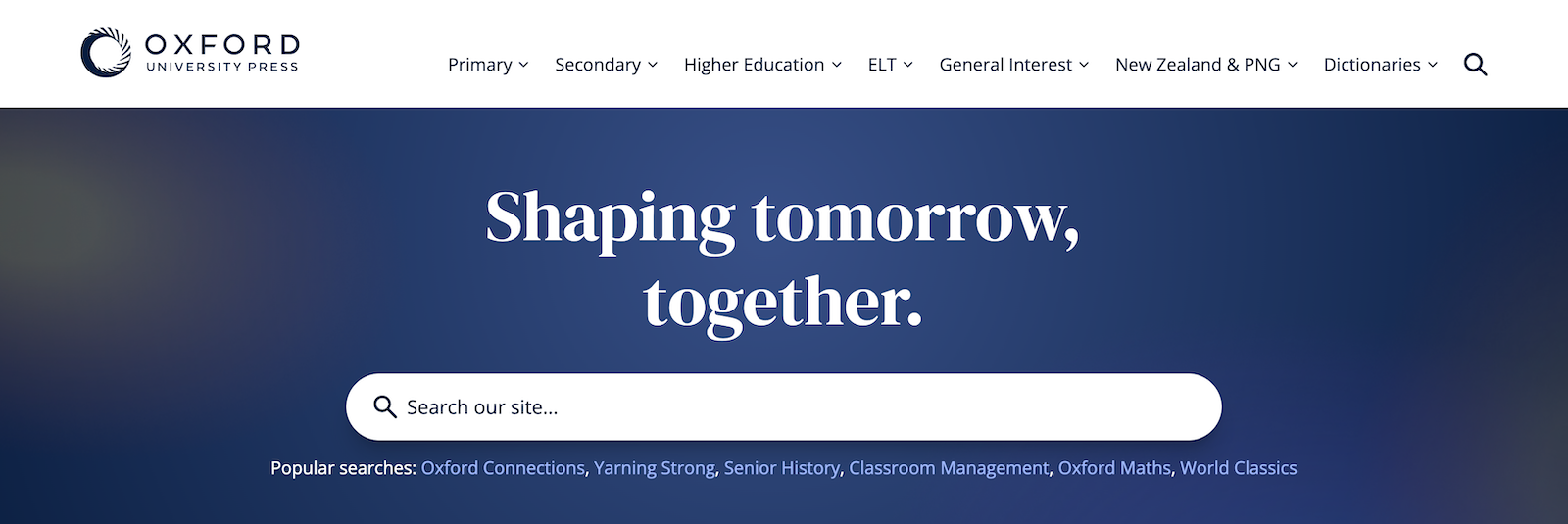
The design: from OUP's brand to a handover Squiz could build from
We designed a scalable design system and page templates in Figma, based on the Oxford Digital Design system, with brand colours from OUP Publishing, and aligned with OUP ANZ brand standards, user needs and what Squiz DXP could deliver. The Figma files were prepared for direct handover to Squiz's frontend team.
The work ran as a preparation phase plus two design sprints. Sprint 1 covered design concepts, navigation and the home page. Sprint 2 covered search, the book page, priority components, all Figma files and additional Squiz components. We designed only what Squiz was building for the migration, and left anything extra for a later phase or for OUP's in-house team.
OUP's team reviewed the work at each showcase. A serif display face for main headings and Open Sans for body text give the site its voice, and contrast and font sizes were designed to meet accessibility standards.
Mobile mattered from the start, because teachers look things up on phones. We held a dedicated mobile design walkthrough with OUP, because static images and Figma files could not show how the site would feel on a phone. When OUP's final review came back very positive overall, with a few mobile details to polish, such as card alignment, we fixed them in Figma. We also set cover image sizes and compression guidance so book covers stay sharp without slowing pages. We completed the design contract on 7 November 2025.
Designed by us, built by Squiz
Squiz was the technology partner for the build. Squiz built oup.com.au on Squiz DXP.
On 16 October 2025, we ran a preliminary design handover session with OUP and Squiz's team. We walked through the Figma files and implementation notes: about seven page templates and about 15 components, covering the homepage, landing pages, product detail and search results, with mobile versions close behind. Squiz received editable Figma access, a suggested build order (navigation, homepage, footer and search results first) and the book listing component to review.
After the handover, we stayed on to finish the design with OUP's team, including the final review. Design by FrontStage and build by Squiz is a split many government and education teams use, and the handover is what makes it work.

Getting the site ready: content loading
Once Squiz had the templates in place, OUP needed its pages loaded. From 12 January 2026 we migrated 150 content pages from the old site into the new DXP components, mainly series landing pages and standard content pages, from OUP's supplied copy and a shared spreadsheet of required pages. We self-checked each page before handing it over, and OUP's team ran the final quality checks. We also reviewed the new site and made recommendations for SEO improvements.
The new OUP ANZ website went live on 26 March 2026.

Analytics: knowing how teachers move from the site to a sample
OUP's analytics had a long history. When we opened the existing Google Tag Manager container, we found about 90 events and variables, some up to nine years old. They relied on page styles and URLs that would not carry over to the new JavaScript-driven site, so we recommended moving to a data layer, which feeds tracking from the page's own metadata rather than from how a page looks.
In March 2026, before launch, we added Google Tag Manager to the new site's development environment, with GA4 and Google Ads tags firing.
Following a teacher from oup.com.au to a sample sign-up
Teachers sign up for samples and evaluations on Oxford Digital, OUP's separate platform, which has its own analytics that OUP could not change. OUP needed to see the journey from oup.com.au right through to the sign-up, without changing Oxford Digital's Google ID.
Our fix was programmatic UTM links, which tag each link from the new site so the visit shows up in Oxford Digital's own analytics. Those UTM-tagged links came through in the Oxford Digital GA4 data stream, and we set up a Looker Studio report to follow them.

What we delivered
We set a default meta description, reduced duplicate page titles, updated image alt text and added canonical URLs for frontlist titles. We also tuned Funnelback search and fixed its search analytics.
Value and impact
OUP ANZ went from a platform move and a design brief to a new website that went live on 26 March 2026. We designed it, Squiz built it, and OUP's team has the guides, components and tracking foundations to run it.
- A scalable design system and page templates for oup.com.au, based on the Oxford Digital Design system, with brand colours from OUP Publishing, designed by us and handed to Squiz to build.
- A Book Listing component we specified and built, so marketers can add titles without writing HTML.
- 150 content pages migrated from the old site into the new DXP components.
- Analytics for the new site, including UTM tracking from oup.com.au to Oxford Digital samples.
- A six-person virtual team, led by a single digital producer, from support in 2025 to launch in 2026.
Why this matters for education and public sector teams
If your website team is small, your catalogue is large and your design and build are split across partners, the handover is where projects wobble. OUP ANZ shows how to make it work: a designer who knows the platform, a build partner who receives editable files, and one point of contact who stays with you from first support request to launch day and beyond.

Get in touch
Planning a redesign on Squiz DXP, or need a design that your build partner can run with?
Book a discovery call with Dave Oakley today.