
Primary Industries South Australia Squiz DXP
A seven-month rebuild for fishers, farmers and travellers. Three websites and a two year support and maintenance agreement.
A fisher checking the limit for whiting on a phone, a farmer reading a drought update in the paddock, or a traveller checking fruit fly rules shouldn't have to fight a website for the answer.
We rebuilt PIRSA's main website and related sub-sites on Squiz Matrix in seven months, on time and within a fixed budget, and went live on 30 June 2025. The platform is mobile-first and WCAG 2.2 AA compliant, with concierge search and a reusable design system already extended to Fruit Fly SA.
Client:
Primary Industries South Australia pir.sa.gov.au
Partners
Aplo Digital
Platform
Squiz DXP, CMS, NSW Design System
Duration
7 month project
2 year engagement
Ongoing to 2027
The brief: a decade of updates, and a site people need in the field

After more than ten years of organic updates, the brief was to make PIRSA's digital presence easier to use in the field. Less than 50% of the site was optimised for mobile, and farmers and regional fishers often need answers from a phone. Search needed to return complete, accurate results. Primary regulatory content sat three to five clicks deep. The rebuild also needed to meet modern WCAG accessibility standards, including stronger screen reader support.
SARDI, PIRSA's self-funded research arm, needed a structured way to showcase its work. The new site also needed to help people find the right information and the right office first time, and to reduce follow-up enquiries. A content freeze was not an option: the department still had to publish on drought, algal blooms and other urgent matters.
Our strategy: rebuild around the task, not the org chart
PIRSA appointed us after a competitive tender, and put a dedicated internal project manager in place to bridge its divisions and our team.
Starting with Aplo, then extending the design
Aplo, an Adelaide UX agency, did the SARDI user research and designs, taking them from concept to mid fidelity. Their work included stakeholder workshops, a heuristic evaluation and user interviews, and key screens that made SARDI easier to find from the PIRSA homepage.
In March 2025 they handed that work to us in Figma, along with their research insights. We then extended the design from there, using the NSW Government Design System (OneCX), and rolled it out as a site-wide refresh of PIRSA. As part of that extension we designed all the Funnelback search results pages, the forms and the Contact page, plus about 20 components.
We also ran discovery with stakeholder workshops across fisheries, biosecurity, agriculture, emergency response and research, plus design system and technical audits. Together with Aplo's research, that let us restructure the information architecture around user tasks rather than internal organisational logic.
This was a full rebuild, not a surface redesign. We redeveloped the template, navigation and content structure, and adapted the NSW Government Design System to PIRSA's brand in Figma. Because that system was already tested for government use, including accessibility, we could focus on customisation and content, and still hit the 30 June 2025 deadline.
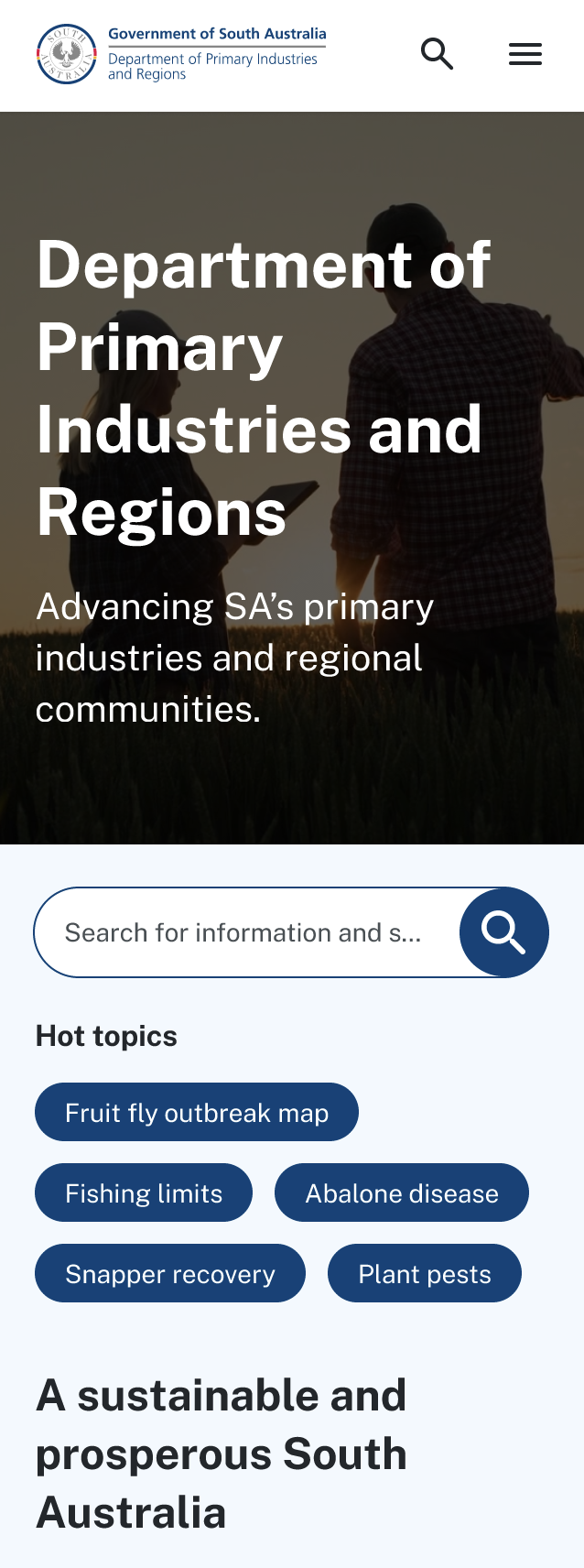
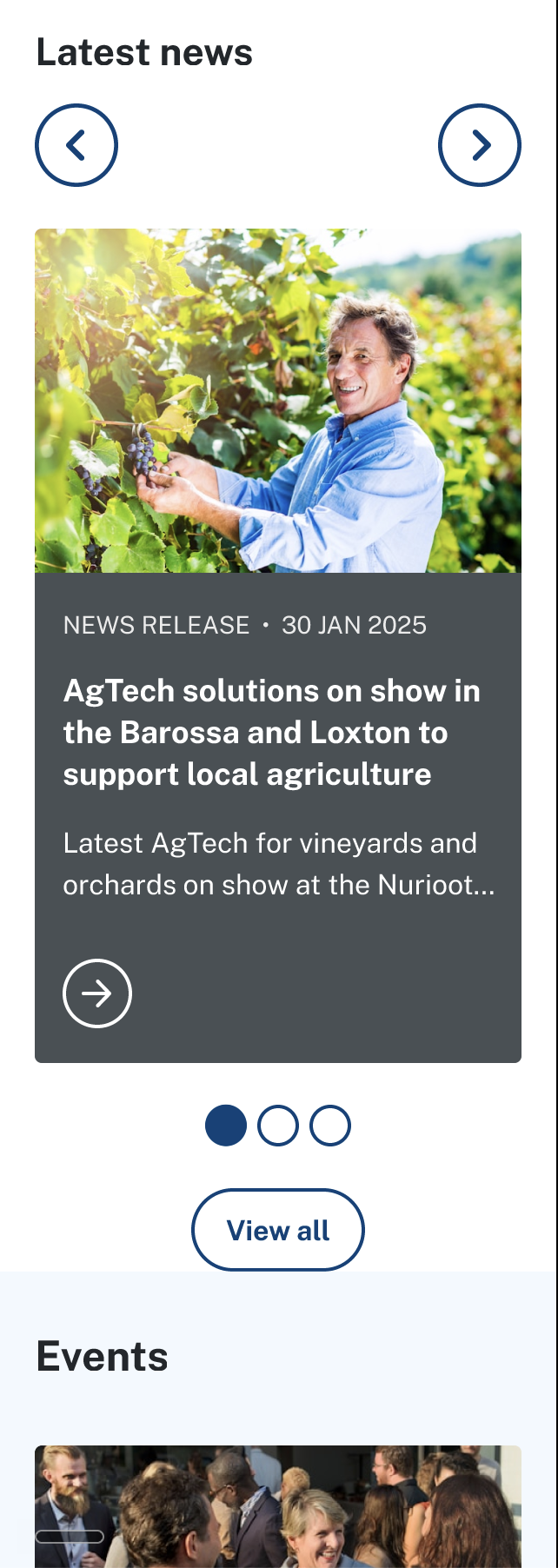
The solution in practice: find it in two clicks, or just type 'whiting'
The biggest experience improvement is concierge search, powered by Funnelback, the CSIRO-developed search engine in the Squiz DXP ecosystem. It offers predictive suggestions and filters across five content types: pages, documents, research publications, news and contacts. We worked with PIRSA's team to recategorise thousands of documents and pages, using bulk metadata uploads from a spreadsheet. A fisheries officer or recreational fisher can type a species name such as 'whiting' and get relevant, filtered results in seconds.
We replaced a narrow, deep structure with a task-based information architecture, including a mega menu on desktop and a simplified mobile navigation. Most content is now within two clicks of the homepage. Every template is mobile-first, including for smaller, older devices in regional and rural areas. We engaged Vision Australia for an independent audit, remediated every issue identified, and achieved a compliance score above 95% against WCAG 2.2 AA.
The Contact Us page uses Google Maps and an AI-powered pre-enquiry tool so people can find the right regional office, with enquiries routed automatically to the appropriate team.
A research hub that makes SARDI's work easy to find
We built SARDI a dedicated document library, searchable by author, program, year and subject, and added a section on the PIRSA homepage. Researcher profile pages automatically link people to their published work through metadata, so years of scientific output are discoverable for the first time.
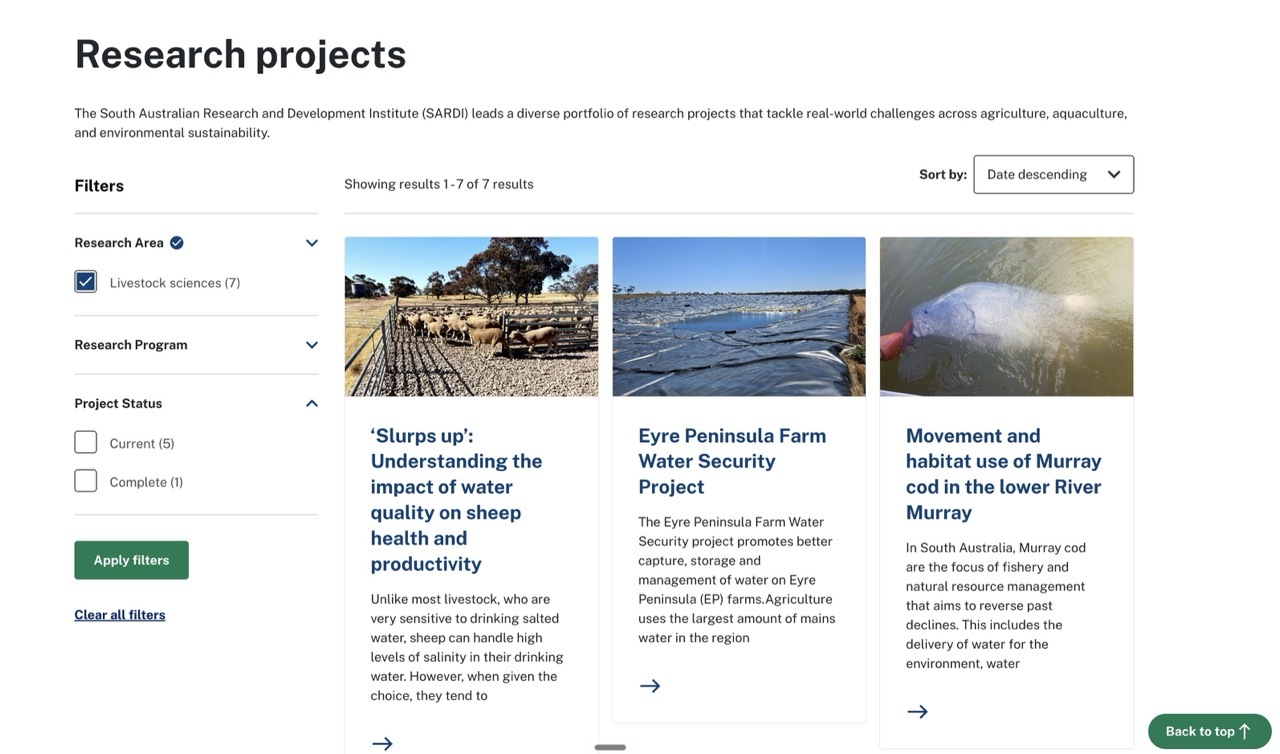
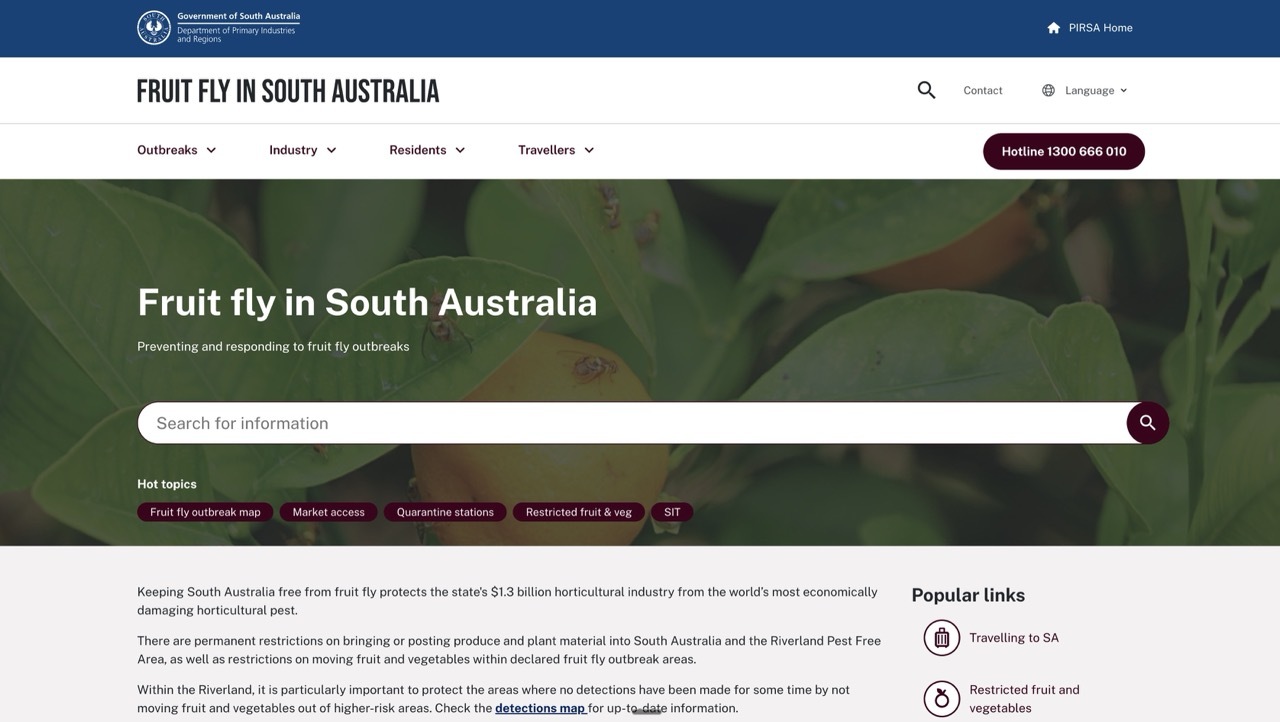
One design system, a three-week Fruit Fly site
After the main site launched, we extended the same design system to Fruit Fly SA, for interstate travellers and South Australian residents navigating strict fruit fly rules. Because the system was already built, tested and accessibility-audited, we re-themed Fruit Fly SA in only three weeks.
Shark sightings, posted live
When someone spots a shark off a South Australian beach, other beachgoers, fishers and boaters need to know quickly.
After the main site went live, we rebuilt PIRSA's report a shark sighting form and the report page that sits with it. Locations auto-complete from a list of South Australian coastal towns, suburbs, beaches and islands, so reports use consistent place names. A submitted sighting is posted live on the page.
In its 2 April 2026 media release, More timely shark sightings, PIRSA described the result: reports from the public are now published live, making it easier for beachgoers, fishers and boaters to stay informed, and PIRSA reviews records afterwards to correct inaccuracies or remove duplicates.

Value and impact: on time, on budget, and already scaling
We delivered on time and within a fixed budget on 30 June 2025, and stayed on. Ongoing support and continuous improvement continued through 2026, with an extension to 30 June 2027.
- 100% of the site is now mobile responsive, up from less than 50%.
- Key content sits two clicks from the homepage, down from three to five.
- Accessibility compliance scored above 95% against WCAG 2.2 AA, after a Vision Australia audit.
- SEO health moved from 40% at launch to 76%.
- SARDI's research is discoverable in a structured library for the first time.
- Fruit Fly SA proved the design system can deliver another site in three weeks.
- After go-live, we rebuilt the report a shark sighting form and page so sightings are posted live for beachgoers, fishers and boaters.
- After the build, PIRSA's internal IT team upgraded the ecosystem to a new version of Squiz DXP. Everything we built migrated easily, with no performance issues.
After go-live, we continued to optimise content, including URL redirects and other SEO work that could only be done once the site was live.

Why it matters for agencies stuck with a decade-old site
When a government site grows organically for more than a decade, people in the field can struggle to find answers, and staff can end up fielding follow-up enquiries. PIRSA shows there is a better path: rebuild around real tasks, invest in search and metadata, and use a proven government design system so you can launch on time and extend to the next site without starting again.

Schedule a meeting with Dave
Book a discovery call with Dave Oakley today.